

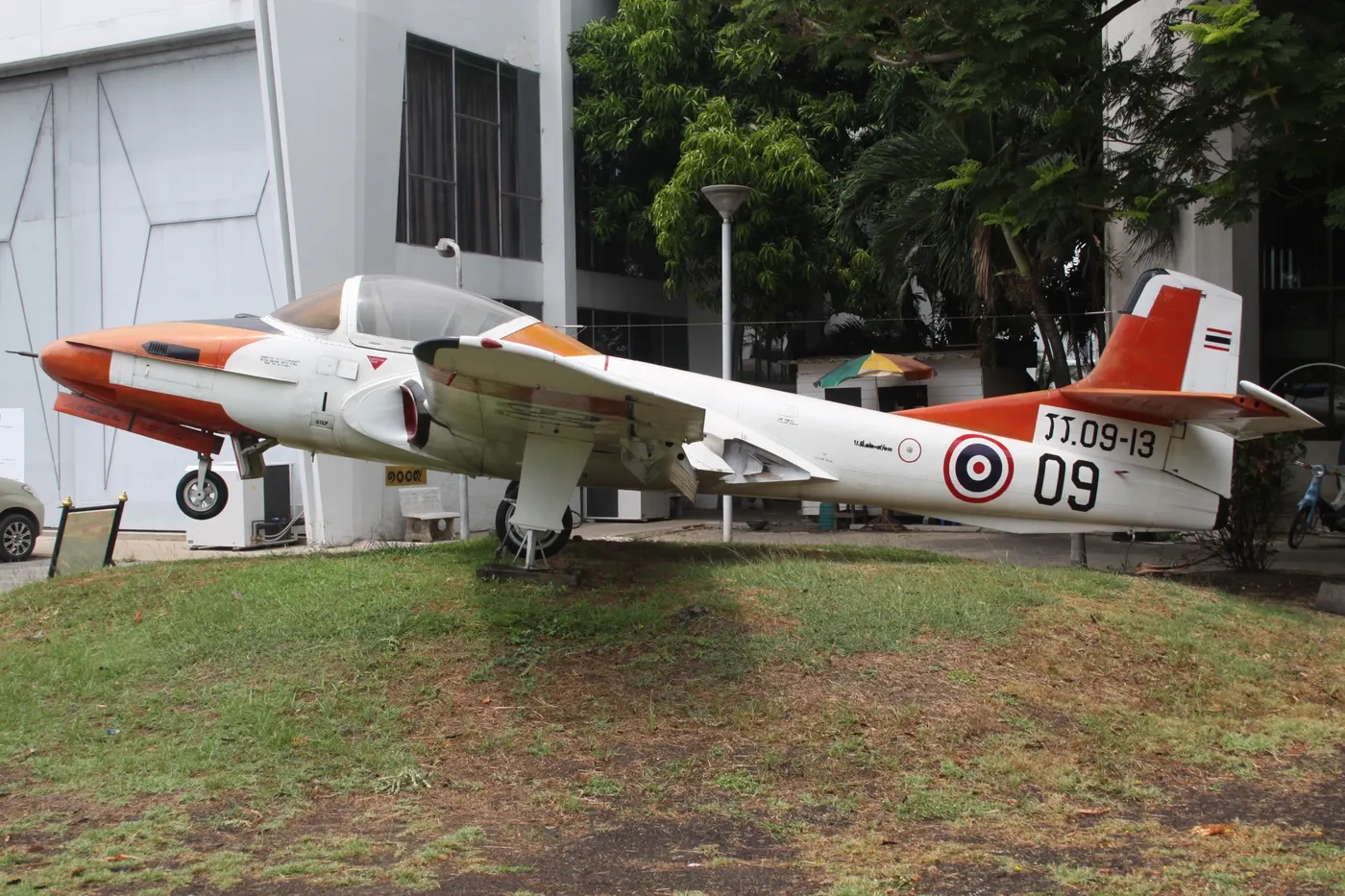
The Cessna T-37C was the armed, export version of the T-37 Tweet, the USAF's side-by-side jet trainer. Cessna developed it from 1961 for Military Assistance Program customers, building 273 through 1975 against 1,269 T-37s of all variants.1 The T-37C added an underwing pylon per side, wingtip tanks, a gunsight, and a gun camera, letting it teach gunnery and, in a pinch, fly light strike.1,2 This article covers that variant, not the T-37's broader story, covered in the main Cessna T-37 Tweet entry.
- Added real weapons training to a cheap, forgiving trainer airframe
- Two pylons covered gunnery, rocketry, and practice bombing in one type
- Wingtip tanks gave enough range for genuine light-attack sorties
- Let export customers get a light-attack option without a separate aircraft
- Weight and drag from pylons and tanks cut top speed by roughly 55 mph
- Armament stayed light, well short of the A-37's punch
- Reconnaissance camera and Sidewinder provision rarely used in practice
The changes cost weight and speed: roughly 1,430 lb (650 kg) added empty weight, and top speed down from about 425 mph (684 km/h) to 370 mph (595 km/h).2 In return, customers ran a full weapons syllabus on one airframe instead of buying a separate attack type.
Turkey and Brazil each took 65 T-37Cs, the largest fleets outside the US; Pakistan eventually held 39 alongside 24 T-37Bs; Portugal, Greece, Burma, Colombia, and Thailand took smaller mixed batches, while Peru bought only the unarmed T-37B.1
The Underwing Pylons That Made a Trainer Combat-Capable

Cessna reworked the T-37B's wing to carry a pylon outboard of each gear well. The standard load was a General Electric multipurpose pod, a .50 caliber (12.7 mm) machine gun with 200 rounds, paired opposite a 70 mm (2.75 in) rocket pod or practice bombs.1,2
Some references also list Sidewinder missiles as compatible, though no operator is documented arming one that way. A gunsight and gun camera scored a student's aim, and an internal camera mount allowed light reconnaissance.1,2
Wingtip Tanks and the Range-for-Speed Trade
The T-37C could mount 65 US gal (245 L) wingtip tanks, jettisonable in an emergency, extending range to about 1,100 mi (1,770 km) against the T-37B's roughly 932 mi (1,500 km).2
Like the T-37B, the T-37C's airframe was built at Cessna's Wichita, Kansas plant, and its two Continental-Teledyne J69 turbojets, an American-built derivative of the French Turbomeca Marboré, were produced domestically under a 1951 license.1 The pylons, gunsight, and General Electric gun pod were likewise US-made.1,2 Export customers received the same American package as the USAF; only the syllabus and stores varied by country.
A 1961 Program Built Around the Weapons Syllabus
Cessna began the armed variant in 1961 once it was clear allied customers wanted to run gunnery and light-attack instruction locally rather than send cadets to the United States.1,6
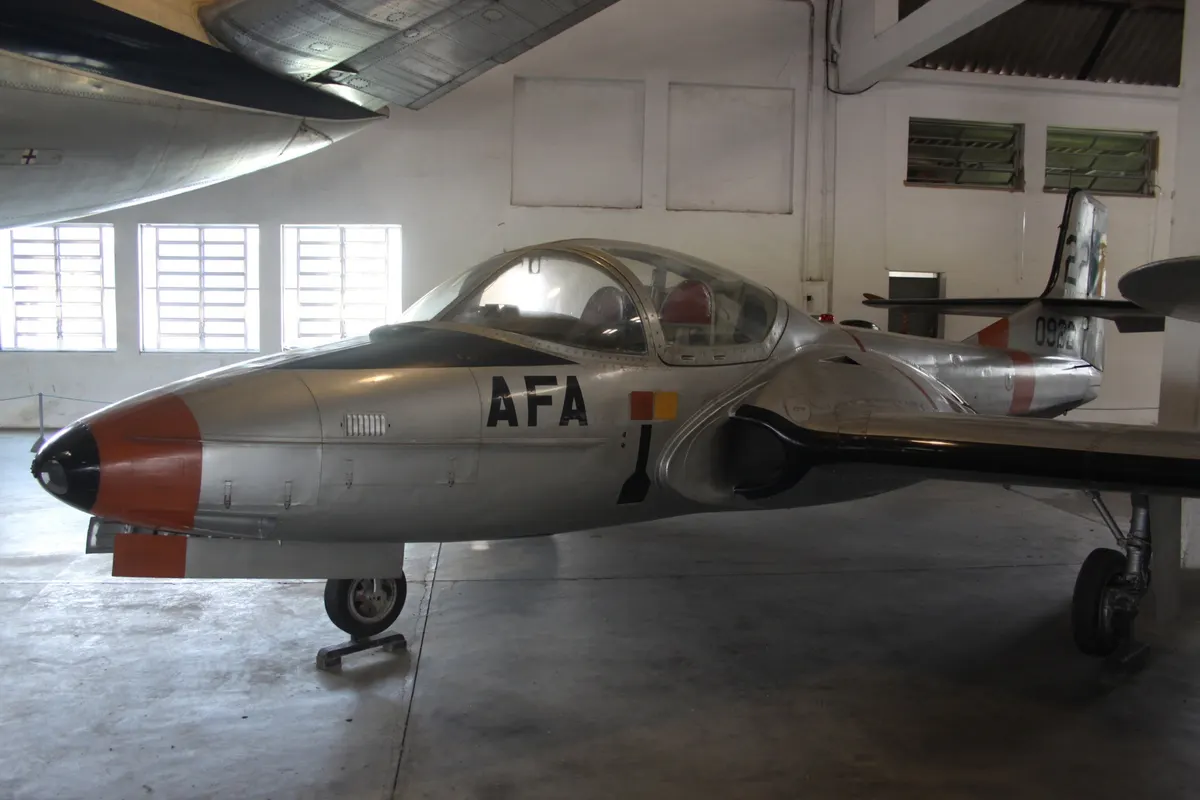
Greece shows how that worked: the Hellenic Air Force formed its 360 Jet Training Squadron in September 1963 at Elefsina Air Base, then moved to Kalamata Air Base in January 1971.5
By 1984 the renamed 361 Squadron flew 18 T-37Cs and 8 T-37Bs, the latter added in 1978; it flew Tweets until October 2002, as Greece moved to the T-6 Texan II.5
The pattern held everywhere: allied air forces ran their own weapons course rather than send students to the United States.
Chile's Beagle Conflict Rearmament
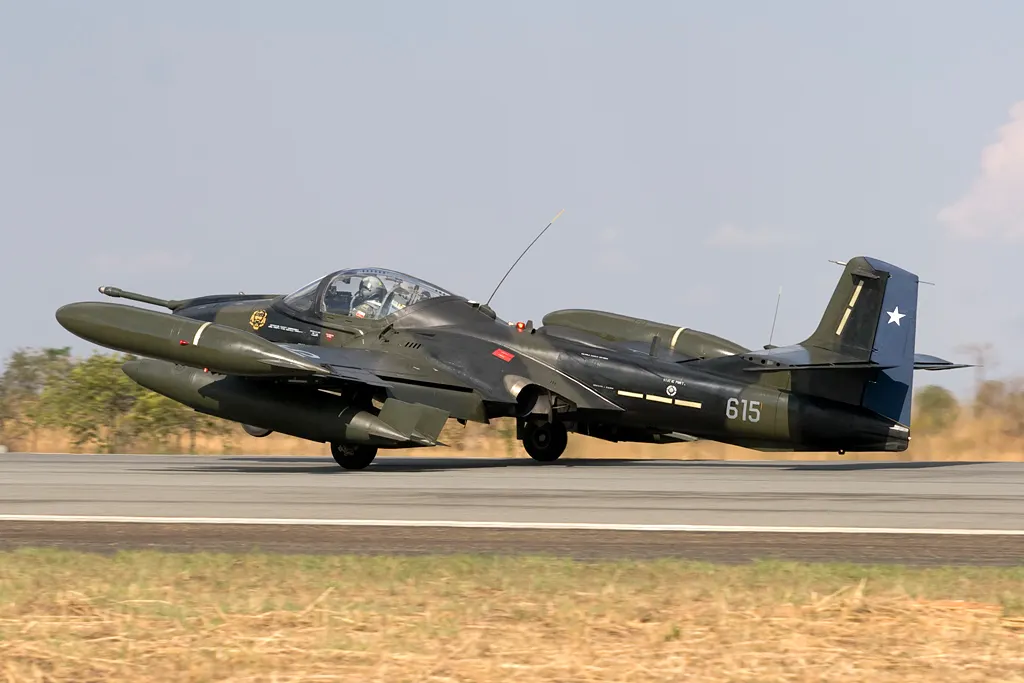
Chile's 32 T-37s, 20 T-37Bs and 12 T-37Cs, served mainly as trainers until a Beagle Channel islands dispute pushed Chile and Argentina toward war in the late 1970s.1 The Chilean Air Force then retrofitted its fleet toward an armed standard reportedly close to the A-37 Dragonfly, well beyond the T-37C's factory pylons.1
Papal mediation defused the crisis before the modified aircraft saw combat; Chile retired both variants in 1998.1
Colombia's Shift From Training to Light Attack

Colombia's small fleet, 4 T-37Bs and 10 T-37Cs, was reoriented from training toward light attack in the early 1980s, overlapping its internal conflict against leftist guerrillas; the pylons made that shift simple on paper.1
Its armament stayed light against a determined insurgency, though; Colombia leaned on its A-37 Dragonflies instead and kept only two T-37s in service before retiring the type on 10 July 2021.1,4
T-37C Versus the Unarmed T-37B
Airframe, engines, and cockpit matched the T-37B; the T-37C differed only in its pylons, tanks, gunsight, camera, and a roughly 1,430 lb weight penalty.1,2 Chile, Greece, and Thailand flew mixed B-and-C fleets, the B for basic flying and the C for weapons work.1
Distinct From the A-37 Dragonfly
The T-37C should not be confused with the A-37 Dragonfly, a far more heavily reworked combat conversion of the same airframe, with roughly double the weight and thrust and a nose minigun; see Comparison, below.3
Turkey and Brazil, the Largest T-37C Fleets
Turkey and Brazil each received 65 T-37Cs, the largest export batches; Turkey flew Tweets into the 2010s, and Brazil sold 30 of its own on to South Korea after a decade of use.1,4
Portugal and Greece, NATO's Southern Flank
Portugal received 30 T-37Cs from 1963, flying them until retirement in 1992.1 Greece's story, above, ran even longer, 1963 to 2002; together the two account for most of the T-37C's NATO presence outside the United States.1,5
Smaller and Later Operators
Smaller fleets went to Burma (12), Colombia, and Thailand (6 T-37Cs alongside 10 T-37Bs); Pakistan and Turkey kept small numbers on strength longest.1,4
T-37C Versus T-37B: What the Weapons Fit Cost
The T-37B was built purely for handling: light, clean, quick off the runway. Pylons, a gunsight, and a camera added roughly 1,430 lb and cut top speed from about 425 mph to 370 mph.2 One aircraft doing both jobs suited budget-limited air forces better than buying two types.
| Spec | T-37C | T-37B |
|---|---|---|
| Top speed | ~370 mph (595 km/h) | ~425 mph (684 km/h) |
| Range | ~1,100 mi (1,770 km) with tip tanks | ~932 mi (1,500 km) |
| Underwing stores | 2 pylons, gun pod / rockets / bombs | None |
| Empty weight | ~1,430 lb heavier than T-37B | Baseline |
T-37C Versus the A-37 Dragonfly: Two Answers to the Same Airframe
The T-37C was a light training modification, capable of attack only in a pinch; the A-37 was a ground-up combat conversion built for sustained counterinsurgency over South Vietnam.3 Chile's push to rebuild T-37Cs toward A-37 standard during the Beagle crisis shows the gap between the two.1,3


What is the difference between the T-37B and T-37C?
The T-37C added two underwing pylons, a gunsight, a gun camera, and optional wingtip tanks to the T-37B airframe, costing roughly 1,430 lb of weight and about 55 mph of top speed.1,2
How many T-37C Tweets were built?
Cessna built 273 T-37Cs between 1961 and 1975, out of 1,269 T-37s across all variants.1
Did the T-37C ever see combat?
No T-37C is documented as having fired in anger; Chile and Colombia both shifted fleets toward an attack role, in 1978 and the early 1980s respectively, without confirmed combat use.1
Is the T-37C still in service anywhere?
Most operators retired the type by the 2010s; Colombia flew its last two until 2021, and Pakistan and Turkey kept small numbers longest.1,4
- "Cessna T-37 Tweet", Wikipedia — en.wikipedia.org ↩
- "Cessna T-37C Tweet, Twin-jet two-seat cantilevered low-wing COIN monoplane, U.S.A.", Skytamer — skytamer.com ↩
- "Cessna A-37 Dragonfly", Wikipedia — en.wikipedia.org ↩
- "Cessna T-37 Tweet, Military Training Aircraft Specs & Operators", GlobalMilitary.net — globalmilitary.net ↩
- "361 Air Training Squadron", Hellenic Air Force — haf.gr ↩
- "Cessna T-37 Tweet Jet-Powered Advanced Trainer / Light Attack Aircraft", MilitaryFactory — militaryfactory.com ↩